

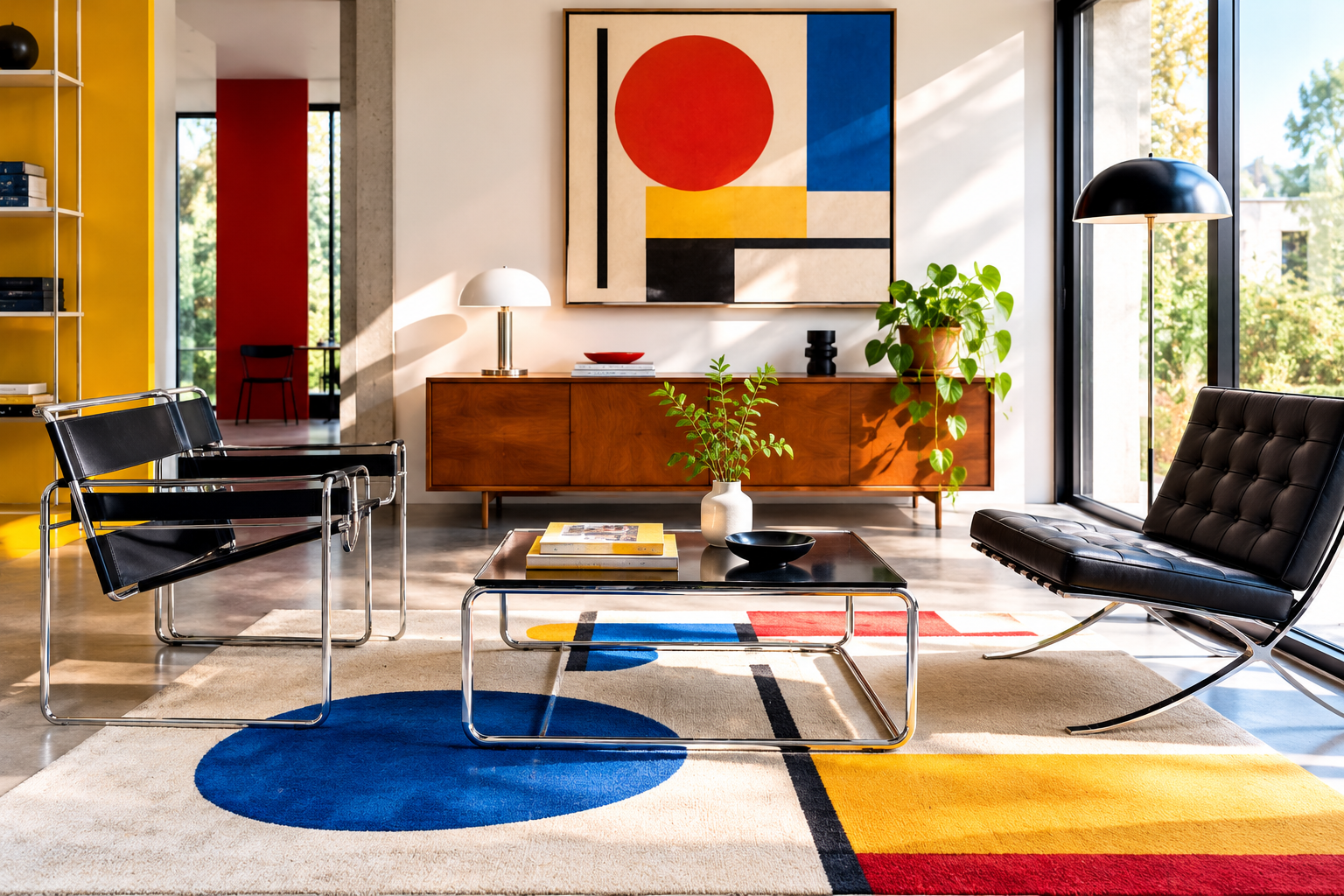
Bauhaus design stands as one of the most influential creative movements of the 20th century. It fundamentally transformed how architects, artists, and designers approach everyday objects, living spaces, and structural forms. Rather than applying surface ornamentation purely for visual appeal, the movement prioritized utility, structural clarity, honest material usage, and clean geometry.
Today, Bauhaus design continues to feel relevant because its core principles align seamlessly with contemporary living. If you appreciate open, clutter-free layouts, geometric precision, highly practical furniture, and a intentional color scheme, incorporating Bauhaus design into your home offers an enduring aesthetic that never goes out of style.
What Is Bauhaus Design?
Bauhaus design is a modern design movement that unites fine art, craftsmanship, industrial technology, and functionalism. The movement originated at the Bauhaus school in Germany in 1919, founded by visionary architect Walter Gropius.
Although the physical school operated for only 14 years before political pressures forced its closure in 1933, its philosophy left an indelible mark on global architecture, product design, typography, and interior decoration.
The Core Philosophy: “Form Follows Function” — The appearance of an object or space should be dictated directly by its intended purpose, eliminating unnecessary embellishments in favor of structural clarity.
A Brief History of the Bauhaus Movement
The historical trajectory of the movement unfolded across three distinct eras, each shaped by its leadership and location:
- The Weimar Era (1919–1925): Founded by Walter Gropius, the school initially focused on bridging the divide between traditional hand craftsmanship and modern fine art.
- The Dessau Golden Era (1925–1932): Moving to Dessau under directors Gropius and later Hannes Meyer, the school embraced industrial mass production. The iconic Dessau Bauhaus building itself became a physical benchmark for modern functionalist architecture.
- The Berlin Phase (1932–1933): Led by famed architect Ludwig Mies van der Rohe, the school briefly operated in Berlin until the regime forced its dissolution.
Following the school’s closure, prominent instructors and students emigrated globally—particularly to North America—spreading the principles of modernism worldwide. Today, historical sites in Weimar, Dessau, and Bernau hold prestigious UNESCO World Heritage designations.
The 5 Main Principles of Bauhaus Design
Understanding the primary foundational principles makes it easy to identify authentic modernist spaces and products.
- Function Comes First: Every structural element, room layout, or piece of furniture must fulfill a concrete purpose before aesthetic considerations are made.
- Pure Geometric Forms: Decoration is replaced by basic shapes—squares, circles, rectangles, and clean linear angles.
- Honest Materials: Materials such as tubular steel, industrial glass, exposed concrete, and solid timber are left exposed rather than hidden beneath decorative coatings.
- Union of Art and Industry: By pairing creative expression with modern machine production, high-quality products were made accessible to the broader public.
- Minimal Ornamentation: Removing superficial details ensures that every item within a space holds genuine value and utility.
What Does Bauhaus Style Look Like?
An interior curated around Bauhaus design features an open, uncluttered, and highly organized layout. Visual weight is balanced, allowing architecture and furniture silhouettes to define the atmosphere.
Key Visual Elements & Materials
| Element Category | Classic Choice | Recommended Application |
| Primary Palette | Red, Yellow, Blue | Used as deliberate accent points on single chairs, rugs, or artwork. |
| Neutral Base | Off-White, Charcoal, Black, Slate | Applied across walls, main flooring, and structural framework. |
| Industrial Materials | Tubular Steel, Tempered Glass, Concrete | Used in furniture legs, table surfaces, and lighting fixtures. |
| Tactile Materials | Natural Leather, Canvas, Hardwoods | Introduced through upholstery and flooring to add organic warmth. |
Iconic Bauhaus Furniture Masterpieces
The movement revolutionized furniture design by adopting industrial materials never before seen in domestic settings.
- The Wassily Chair (Marcel Breuer, 1925): Inspired by the frame of a bicycle, Breuer utilized bent tubular steel and leather straps to create a lightweight, comfortable armchair strip of excess weight.
- The Barcelona Chair (Mies van der Rohe & Lilly Reich, 1929): Designed for the International Exposition in Spain, this chair combines a sleek, chrome-plated steel frame with hand-tufted leather cushions.
- The Cesca Chair (Marcel Breuer, 1928): A cantilevered chair featuring no rear legs, giving the user the sensation of floating on a flexible steel frame paired with woven cane.
- The MT 49 Glass Lamp (Wilhelm Wagenfeld): An iconic desk lamp featuring a clean glass dome and metallic stem, demonstrating pure functional illumination.
Influential Masters and Pioneers
The school brought together some of the most groundbreaking creative minds of the 20th century:
- Walter Gropius & Ludwig Mies van der Rohe – Architectural visionaries and school directors.
- Marcel Breuer – Pioneer of tubular steel furniture and modular living design.
- Wassily Kandinsky & Paul Klee – Legendary painters who taught foundational color theory and form analysis.
- Herbert Bayer – Master typographer who revolutionized modern layout design and minimalist fonts.
How to Make Bauhaus Interiors Feel Warm
A common concern is that strict functionalism can feel overly sterile or clinical. You can preserve structural integrity while creating an inviting home environment using these techniques:
- Incorporate Warm Timber: Balance cold steel and glass by introducing warm oak or walnut wood tones through flooring or shelving.
- Introduce Soft Textiles: Use natural linen curtains, wool rugs, and textured cushions to soften hard geometric edges.
- Add Layered Lighting: Replace bright overhead lights with warm-toned lamps (2700K–3000K) positioned at different heights.
- Integrate Natural Greenery: Potted indoor plants bring organic shapes, texture, and natural color into structured rooms.
Bauhaus Graphic Design, Typography & Architecture
The movement’s influence extended far beyond residential interiors:
- Typography & Layouts: Herbert Bayer created the “Universal Typeface,” eliminating capital letters in favor of clean, uniform sans-serif forms. Modern web layouts, packaging, and corporate branding still rely on grid systems pioneered during this era.
- Architectural Breakthroughs: Structural features like glass curtain walls, flat roofs, steel beam skeletons, and open-plan floors were popularized by the movement, defining modern city skylines worldwide.
Bauhaus vs. Minimalism: Key Differences
While both styles champion simplicity, they originate from different creative philosophies:
- Bauhaus Design: A synthesis of art, technology, craftsmanship, and geometry. It welcomes bold primary color accents, mixed industrial textures, and structural expression.
- Minimalism: A broader lifestyle and aesthetic approach focused strictly on reducing visual elements to achieve maximum simplicity, calm, and neutral monochrome spaces.
Step-by-Step: Adding Bauhaus Style to Your Home
Adopting this look does not require a complete renovation. Follow these simple steps to transform your living space:
- Declutter the Space: Remove ornamental accessories that serve no clear functional purpose.
- Establish a Neutral Base: Paint walls in soft white, light gray, or neutral tones to maximize light reflecting throughout the room.
- Select a Focal Furniture Piece: Choose a single statement piece, such as a cantilever chair or a steel-framed coffee table.
- Apply Controlled Primary Accents: Introduce a bold red, blue, or yellow cushion, throw blanket, or abstract geometric print.
- Optimize Lighting: Install sleek metallic floor lamps or glass pendant lights that combine effective task illumination with sculptural design.
Frequently Asked Questions
1. Is Bauhaus design suitable for small apartments?
Yes. The emphasis on open layouts, lightweight steel furniture frames, and reflective glass surfaces makes small rooms feel significantly larger and less congested.
2. What is the difference between Bauhaus and Mid-Century Modern?
The former emerged in 1920s Germany with a heavy focus on industrial materials and strict geometric forms. Mid-Century Modern evolved in the 1950s, building upon those concepts while incorporating softer organic curves, warmer hardwoods, and molded plastics.
3. How can I achieve a Bauhaus look on a budget?
Focus on decluttering, selecting simple clean-lined furniture, framing primary-colored geometric art prints, and opting for minimalist metallic desk lamps rather than expensive vintage reproductions.
Final Thoughts
Bauhaus design remains enduringly popular because it offers a practical, timeless framework for living. Rather than chasing short-lived decor trends, it encourages us to eliminate clutter, select functional objects crafted from honest materials, and construct rooms that genuinely improve daily life.
Whether you are redesigning an entire home or introducing a single geometric armchair, applying the principles of Bauhaus design brings clarity, structure, and lasting sophistication to any modern space.
